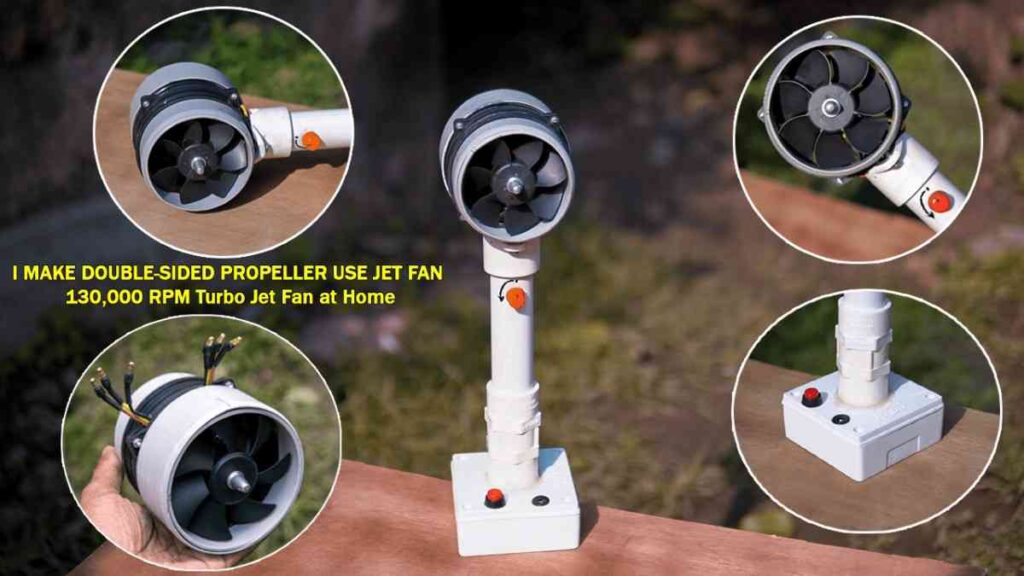
Hi friends! Today, I am going to build a double-sided propeller jet fan using a 130,000 RPM turbo jet motor right here at home. If you would like to build one yourself, read this post carefully—then you, too, will be able to create your very own double-sided propeller jet fan!
Double-sided propellers are frequently used in specialized jet fan devices, primarily in industrial, mining, and high-performance, compact cooling applications to maximize airflow efficiency. These systems, often referred to as contra-rotating or twin-axial fans, use two propeller impellers that rotate in opposite directions to straighten the airflow and increase pressure.
DC Fan Usage
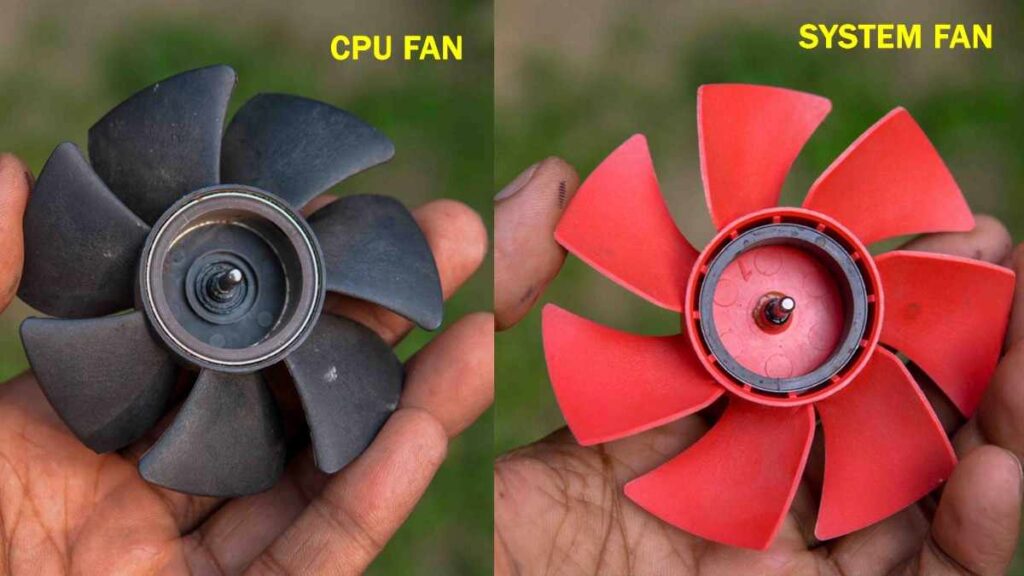
I have used three fans here—one CPU fan and two system fans (which can also be referred to as DC fans). I will also explain the reasons behind using a CPU fan as well as the DC fans. Let’s find out what those reasons are.
Regarding the fans I have used: one rotates clockwise while the other rotates counter-clockwise; yet, the airflow is directed toward the exact same direction—this constitutes its primary mechanism.
It is precisely because of this feature that its power output is significantly enhanced. Consequently, this mechanism is utilized in large aircraft, heavy-lift planes, and helicopters.
The CPU fan rotates to the right; in addition to that, you should install another fan—either a system fan or a DC fan—that rotates to the left, yet ensures the airflow is directed in the same direction.
Use of Motors
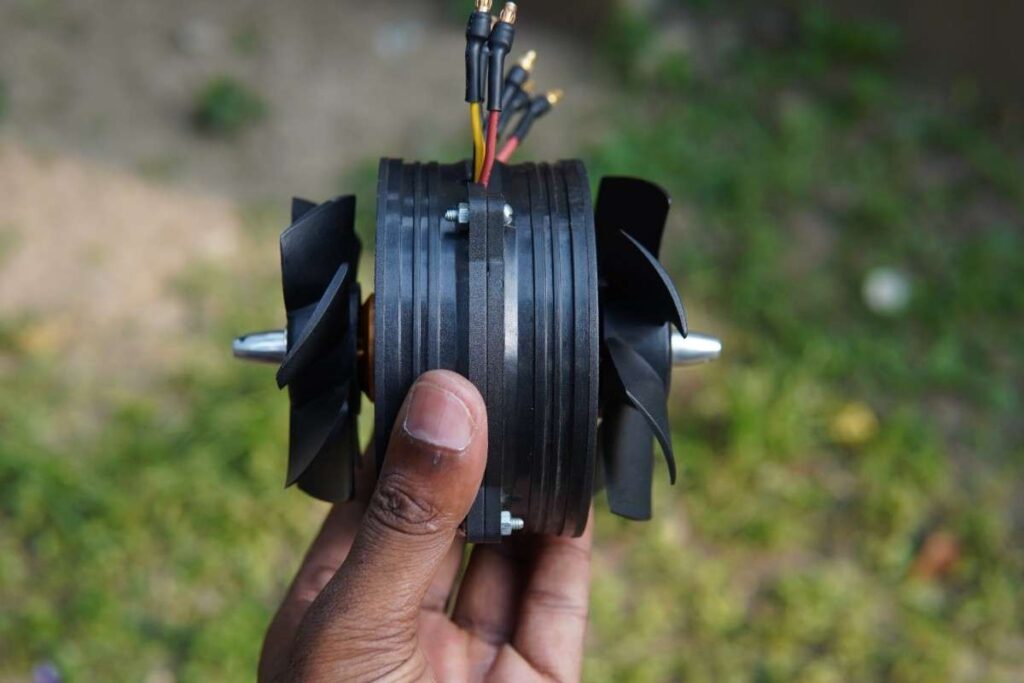
I have used a 2200KV BLDC motor here; this is the compact ‘Pro Plus’ model, which operates at very high RPMs and generates a significant amount of airflow.
Here, I have used two motors: one rotates clockwise and the other counter-clockwise, yet the airflow from both will be directed in the same direction.
Mobile Battery Usage
Friends, here I have used Lithium Polymer batteries—specifically, six used mobile phone batteries. Additionally, I have incorporated a 30-ampere BMS.
I am encountering a significant issue here whenever I run this turbo fan at full speed: the fan shuts down completely.
The primary reason for this shutdown is that when this jet fan draws high amperage,
the battery—or more precisely, its BMS—simply lacks the capacity to handle the load, causing the unit to cut power entirely.
Here, if you use an 80-ampere or 100-ampere BMS from a reputable brand—which is highly recommended—you will experience a significant performance boost.
It will spin at double the speed I have observed; the use of such components is precisely what enhances its velocity. Furthermore, utilizing high-quality batteries ensures excellent battery life.
SERVO TESTER MOTOR BLDC
Here, I have utilized a servo tester. I have connected the two terminals of the BLDC ESC to this servo tester; specifically, these connections are routed to the tester’s output ports.
Now, as I rotate the servo tester’s potentiometer dial, the speed will automatically increase or decrease.
Building a double-sided propeller (often referred to as a contra-rotating or dual-fan setup) using a 130,000 RPM Turbo Jet Fan is an ambitious project but carries extreme mechanical risks due to the immense centrifugal forces at that speed. [1, 2]
Key Considerations for Your Build
- Extreme RPM Risks: At 130,000 RPM, any imbalance can cause the blades to shatter or “explode” outward. Standard hobby propellers or DIY blades made from simple materials like PVC are generally not rated for these speeds.
- Structural Integrity: Professional-grade turbo fans use high-strength materials (like PEEK or reinforced alloys) and containment rings to prevent catastrophic failure if a blade breaks. A “double-sided” setup increases vibration loads and mechanical complexity significantly.
- Balancing is Mandatory: You must use a dynamic balancer. A static balancer (gravity-based) is not precise enough for 130,000 RPM. Even a tiny weight difference between blades will destroy the motor bearings in minutes. [3, 4, 5, 6, 7, 8, 9]
Design Approaches
- Dual-Fan Housing: Most high-speed “jet fan” projects use a single impeller in a tight duct to maximize thrust. Adding a second propeller (double-sided) requires either a very long shaft or a dual-spool motor setup to handle the opposing torque.
- 3D Printing: If 3D printing blades, use materials with high heat and impact resistance like PETG or Carbon Fiber Nylon. PLA is likely to deform or shatter under the heat and stress.
- Ducted Design: To be effective, the propellers should be encased in a shroud (duct). This improves efficiency and provides a small measure of safety if a blade fails. [3, 10, 11, 12, 13]
Critical Safety Precautions
- Test Behind a Shield: Never test a 130,000 RPM motor in an open area. Use a thick polycarbonate (Lexan) shield or a heavy metal enclosure.
- Dynamic Balancing: Use software-assisted tools like a Dynamic Propeller Balancer to ensure the assembly is perfectly centered.
- Cooling: High-speed BLDC motors generate intense heat. Ensure your housing allows for airflow over the motor casing or use a heatsink. [3, 7, 14, 15]
Are you planning to use 3D-printed blades or pre-made impellers for this double-sided setup?